What I Would Different if I Were a Bishop Again
Bridget Bishop was the commencement victim to be hanged during the Salem Witch Trials of 1692.
Bishop, whose maiden name was Playfer, was born sometime between 1632 and 1635 in England.
In 1660, she married her offset husband, Samuel Wasselby, in England and moved to the Massachusetts Bay Colony effectually the aforementioned time.
Later Wasselby died in 1664, Bridget married her 2nd husband in 1666, a widower named Thomas Oliver who already had children from his previous marriage. Bridget and Thomas Oliver had one child together, a daughter named Christian who was born in Salem on May 8, 1667.
Bridget and Thomas Oliver had a troubled relationship. The couple quarreled often and were even brought to court for fighting in 1670, during which their neighbor, Mary Ropes, testified that Bridget'south face was bloodied and bruised on a number of occasions, co-ordinate to the book Salem-Village Witchcraft: A Documentary Record of Local Conflict in Colonial New England:
"Mary Ropes, aged about l years, deposed that she had several times been called to her neighbor Thomas Oliver'south, by himself, but by and large by his wife, to hear their complaints i of the other, and they both acknowledged that they had been fighting together. Further she saw Goodwife Oliver'southward face up at one time bloody and at other times black and blueish, and the said Oliver complained that his wife had given him several blows."
Bridget and Thomas Oliver were fined and ordered to be whipped if they did not pay their fine on fourth dimension.
In 1678, Bridget was brought to court for using foul language confronting her husband, every bit described in the book Salem-Village Witchcraft:
"Bridget, wife of Thomas Oliver, presented for calling her husband many opprobrious names, as old rogue and erstwhile devil, on Lord's day, was ordered to stand up with her husband, back to back, on a lecture day in the public market place, both gagged, for almost an hour, with a paper fastened to each others foreheads upon which their crime should be fairly written."
After Oliver died of an disease in 1679, Bridget inherited his manor, which consisted of a house worth £45, x acres of land worth £25, a diverseness of household goods and two pigs. Oliver's ii sons and the couple'due south daughter only received twenty shillings each.
Just three months after receiving her inheritance in November, Bridget'south stepchildren accused her of bewitching Oliver to expiry. A lack of evidence prevented the instance from going to trial and it was speculated that the stepchildren's accusation was an attempt to get their hands on the property she inherited from their father.
In 1687, Bridget was and so accused of stealing brass from a local manufactory by the manufactory owner, Thomas Stacy, and arrested. Bridget claimed she didn't steal the brass, but found information technology on her holding and had no thought how information technology got there.
She also stated that she sent her daughter into town with the brass to discover what information technology was, non to sell information technology, equally Thomas Stacy accused her of doing. Unfortunately, there are no surviving records indicating the consequence of this trial.
Subsequently Oliver's death, Bridget Bishop married Edward Bishop, a well-respected sawyer (woodcutter). Bridget Bishop'south life at this fourth dimension is sometimes difficult to trace considering many historians, including Charles Upham in his 1867 volume Salem Witchcraft, accept confused her with Sarah Bishop, who was likewise accused of witchcraft and was married to Bridget Bishop's step-son, who was besides named Edward Bishop, according to the book Salem Story:
"As the first person to be executed in the Salem Witch Trials, Bridget Bishop has received plenty of attending from Salem's historians, amateur and professional. She has served as a paradigm of the executed person as social deviant, the outsider who falls prey to a customs devouring the eccentric on its margin. This is a version of Salem's story codified in 1867 by Charles Upham, who in his Salem Witchcraft told the story of Bridget Bishop as a singular graphic symbol, not easily described. 'She kept a business firm of refreshment for travellers, and a shovel-board for the entertainment of her guests, and generally seems to accept countenanced amusements and gayeties to an extent that exposed her to some scandal. She is described as wearing 'a black cap and black hat, and a red paragon bodice,' bordered and looped with different colors. This would appear to take been a rather showy costume for the times. Her liberty from the austerity of Puritan manners, and disregard of conventional decorum in her conversation and behave, brought her into disrepute; and the tongue of gossip was generally loosened confronting her.' Upham had made a fault. Although he correctly identified Bridget Bishop as a adult female who previously been charged with witchcraft, he conflated two people into one, inaccurately identifying her as living just exterior of Salem Village, rather than in Salem [town] where she did live, and of being a rather colorful tavern keeper, which she was not. Upham's mistake was understandable, since the confusion as to her identity actually goes back to 1692, and only some brilliant detective work past David L. Greene in 1981 brought clarity to the matter; yet, some scholars accept continued to make the misidentification."
The mistake originates from Reverend John Unhurt's testimony against Sarah Bishop on May 22, which many historians have misidentified every bit testimony confronting Bridget Bishop because during the testimony Hale merely refers to the defendant equally "Goodwife Bishop…married woman of Edward Bishop Jun'r."
Since Bridget and Sarah Bishop were both accused of witchcraft and were both married to men named Edward Bishop, it's easy to come across how the ii became mixed up over time.
Bridget Bishop & the Salem Witch Trials:
What historians do know about Bridget Bishop is that around the time of the Salem Witch Trials, she lived in what is now downtown Salem.
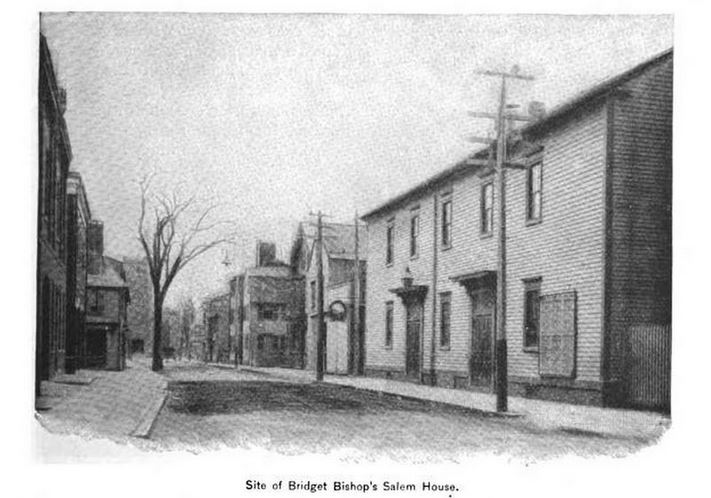
She endemic an apple orchard, which was located at what is now 43 Church building Street (where the Salem Lyceum Society building was later built), where she also kept chickens. Bishop also lived in a house somewhere near the orchard, according to court records.
Bridget Bishop was arrested on charges of witchcraft on April xviii, 1692, later she was defendant by Mercy Lewis, Abigail Williams, Elizabeth Hubbard and Ann Putnam, Jr.
Bishop was examined the adjacent day in Salem Village past Approximate John Hathorne and Approximate Jonathan Corwin. Hathorne wasted no time bringing upwardly Bishop's prior accusation of witchcraft, according to courtroom records:
"[Hathorne]: They say you bewitcht your first husband to death.
[Bishop]: If it delight your worship I know naught of information technology.
She milkshake her caput & the afflicted were tortured.
The like again upon the motion of her head.
Sam: Braybrook affirmed that she told him to day that she had been deemed a witch these ten years, but she was no witch, the Devil cannot hurt her.
[Bishop]: I am no witch.
[Hathorne]: Why if y'all have not wrote in the volume, yet tell me how far you
have gone? Accept you not to do with familiar Spirits?
[Bishop]: I have no familiarity with the devil.
[Hathorne]: How is information technology then, that your appearance doth injure these?
[Bishop]: I am innocent.
[Hathorne]: Why you seem to human activity witchcraft earlier the states, by the movement of your
body, which seems to take influence upon the afflicted?
[Bishop]: I know nil of it. I am innocent to a witch. I know not what
a Witch is.
[Hathorne]: How do yous know and so that y'all are not a witch?
[Bishop]: I practise not know what you say.
[Hathorne]: How tin can you lot know, you are no witch, & nevertheless not know what a
witch is?
[Bishop]: I am clear: if I were any such person you should know it.
[Hathorne]: You may threaten, but y'all can exercise no more you are permitted.
[Bishop]: I am innocent of a witch."
That same day, Bridget Bishop was indicted and arraigned on v separate charges of witchcraft. The amount of evidence against Bishop was overwhelming. Over the form of the next few months, over x witnesses gave long, detailed testimonies about how Bridget Bishop bewitched them, their family unit and/or their animals.
Once such witness was John Louder who testified that eight years before, when he was staying with Bridget Bishop's neighbor, John Gedney, Gedney would often quarrel with Bishop well-nigh letting her chickens wandering into his apple orchard.
Presently after, Louder claimed Bishop'south spirit would assail him at night in his bed and when he complained to Bishop about it, she threatened him and sent blackness pigs and a talking plain-featured monkey to torment him, co-ordinate to court records:
"Susannah Gedney was in our orchard and I was then with her and said Bridget Bishop beingness then in her orchard which was next adjoining to ours my mistress told said Bridget that I said or affirmed that she came i night & sat upon my breast as aforesaid which she denied and I affirmed to her face to be true and that I did plainly encounter her, upon which discourse with her she threatened me. And some time later that I being non very well stayed at home on a Lords 24-hour interval and on the afternoon of said day the doors existence close I did see a black hog in the room coming towards me so I went towards it to boot it and it vanished abroad. Immediately afterward I sabbatum downward in an narrow bar and did see a black thing bound into the window and came & stood just earlier my face, upon the bar the body of information technology looked like a monkey only the feet ware similar a cocks feet with claws and the face somewhat more than similar a mans than a monkey and I beingness greatly affrighted non being able to speak or assist myself by reason of fear I suppose, so the thing spake to me and said 'I am a Messenger sent to you for I understand y'all are troubled in mind, and if you volition be ruled by me you shall want for nothing in this world' upon which I endeavored to handclapping my hands upon it, and said 'You devil I will kill you,' only could feel no substance and information technology jumped out of the window once again and immediately came in by the porch although the doors were close and said 'You had improve take my council,' where upon I strook at it with a stick just strook the ground sill and broke the stick, just felt no substance, and that arm with which I strook was presently disenabled, then it vanished abroad and I opened the back door and went out and going towards the house end I espied said Bridget Bishop in her orchard going towards her firm, and seeing her had no ability to gear up ane foot forward but returned in again and going to shut the door…"
Louder claimed to meet the monkey on another occasion flying in the apple tree orchard and said he knew that it was real because it knocked apples off the trees as it flew over them.
Other witnesses, such as Samuel Gray, testified that Bishop bugged his child to death fourteen years earlier when her spirit suddenly appeared at his firm ane nighttime, according to court records:
"Samuel Grayness of Salem Aged well-nigh 42 years testifieth and sayth that nigh fourteen years ago he going to bed well one Lords Twenty-four hours at dark, and after he had been asleep some fourth dimension, he awakened & looking up, saw the house calorie-free every bit if a candle or candles were lighted in it and the door locked & that picayune fire there, was raked upwardly he did then run across a woman standing between the cradle in the room and the bed side…and the child in the cradle gave a groovy screech out as if it was greatly injure and she disappeared and taking the child upwardly could non quiet information technology in some hours from which time, the child that before was a very likely thriving child did pine away and was never well, although it lived some months later on, even so in a sorry condition and and so died, some fourth dimension after within a calendar week or less he did see the same woman in the same garb and clothes, that appeared to him as aforesaid, and although he knew not her, nor her proper noun before, however both by her countenance & garb doth testify that it was the same adult female that they now call Bridget Bishop alias Oliver of Salem."
One of the affected girls, Susannah Sheldon also testified that she saw the spirit of Thomas Green'south twin boys who told her that Bridget Bishop had bewitched them to death. She likewise said Bridget Bishop's spirit told her she had killed four women, two of them were "the Foster'southward wives," one was John Trask'southward married woman and she didn't name the other.
Two other witnesses, Samuel and Sarah Shuttuck gave a long, rambling testimony well-nigh how Bridget Bishop first asked them to dye a minor piece of lace that they believed couldn't exist used for anything other than a poppet (a blazon of doll used in witchcraft), then bewitched their eldest child and physically attacked the child in person when she was confronted nigh bewitching him.
John Bly and his wife Rebecca as well testified that Bridget Bishop sold them a bewitched pig. John Bly and William Bly besides testified that they were hired past Bishop to practise some construction work on her dwelling and found poppets hidden in the walls of her cellar, according to courtroom records:
"June two'th 1692 John Blye Senior anile nearly 57 years & William Blye aged about xv years both of Salem testifieth and sayth that being employed past Bridget Bishop allonym Oliver of Salem to aid accept downwards the cellar wall of the former business firm she formerly lived in we the said deponants in holes of the said old wall belonging to the said cellar establish several poppets made upwards of rags and grunter beard with headless pins in them with the points outward & this was virtually 7 years terminal past."
At nigh ten a.m. on June 2, Bridget Bishop, Elizabeth Proctor, Rebecca Nurse, Alice Parker, Susannah Martin and Sarah Proficient underwent a humiliating physical examination by 9 local women and a doc named Barton, after which these examiners reported finding unnatural growths in strange places on some of the accused, including Bishop:
"The first three, namely: Bishop, Nurse and Proctor, by diligent search have discovered a preternatural excrescence of flesh betwixt the pudendum [genitals] and anus much similar to teats & non usual in women & much different to the other three that hath been searched past us & that they were in all the three women near the aforementioned place."
The women were all examined again about six hours later, subsequently which the examiners reported that Bridget Bishop and Elizabeth Proctor were clear of any witch marks and that every bit far as the other women were concerned, the unusual scrap of flesh only appeared to be dry skin.
Bridget Bishop'southward trial began and ended that same day, co-ordinate to the book Legal Executions in New England:
"The trial of Bridget Bishop opened in Salem on June two, 1692. It was a one-day affair. Seven judges headed by Deputy-Governor William Stoughton comprised the courtroom. Bridget was allowed no counsel; at least no 1 is known to have risked their skin to defend her. The bear witness produced was merely a rehash of the scurrilous stories that long circulated nearly her. The prevailing lunacy of the 'affected girls' counted heavily against her too. Cotton wool Mather, who later wrote of the trial, captured the quintessence of the proceedings when he remarked, 'There was little occasion to prove the witchcraft, information technology being evident and notorious to all beholders.' Bridget Bishop was predoomed by popular opinion and prejudice."
The jury institute Bridget Bishop guilty of witchcraft and issued her death warrant on June viii, 1692.
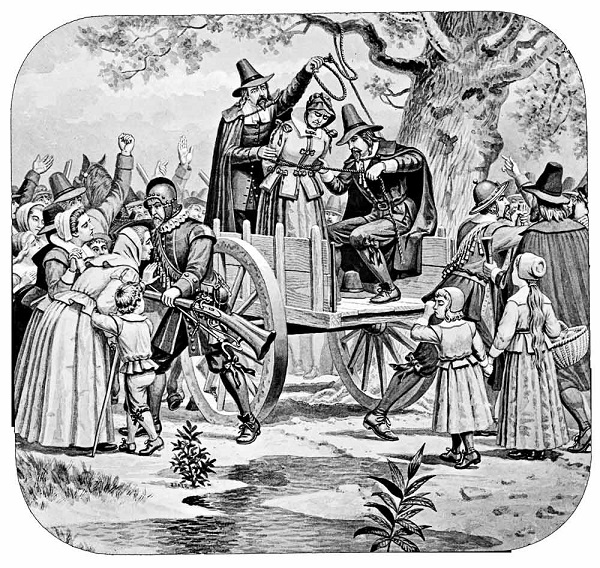
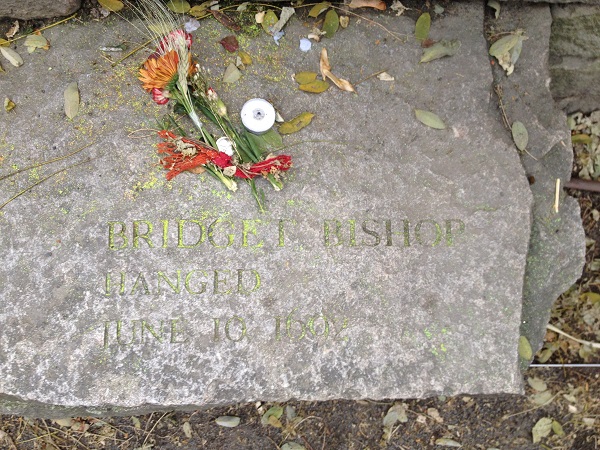
On Friday, June ten, 1692, onetime between 8am and noon, Bridget Bishop was taken to the execution site at Proctor's Ledge in Salem and hanged.
Every bit a convicted witch, she wasn't allowed to be buried in consecrated ground so she was cached at the execution site, co-ordinate to the book Witch Hill: A History of Salem Witchcraft:
"Sheriff Corwin, in his official return in the example of Bridget Bishop, which has been preserved, subsequently stating the fact of having hanged her, adds, 'and buried her on the spot,' simply drew his pen across the words, as if the argument were not necessary to the return."
Bridget Bishop was not the offset victim accused during the Salem Witch Trials of 1692, but it is believed that officials chose to hear her example starting time because they felt, given her prior history and reputation, it would exist an easy win. They were right and a string of other convictions and executions followed hers before the hysteria came to an finish in 1693.
In 1711, the Massachusetts legislature passed a bill clearing the names of some of the accused and granted restitution to their families. Bishop's family, and several others, did not come forward to have the restitution nor to be named in the bill and, therefore, their names were not cleared.
In 1957, the Massachusetts legislature officially apologized for the Salem Witch Trials and cleared the names of "One Ann Pudeator and certain other persons" but failed to mention the remaining victims past name.
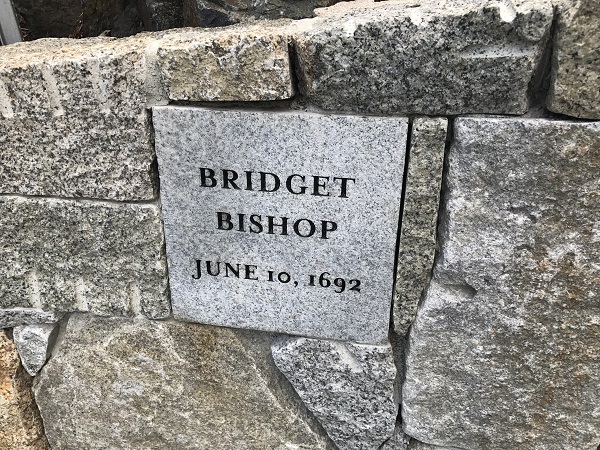
In 1992, the Salem Witch Trials Memorial was congenital in Salem, Mass and a marking was established for Bridget Bishop.
In 2001, the Massachusetts Legislature amended the 1957 apology and finally cleared the names of the remaining victims: Bridget Bishop, Susannah Martin, Alice Parker, Wilmot Redd and Margaret Scott.
In 2017, the Proctor's Ledge Memorial was built in Salem, Mass and a marker was established for Bridget Bishop.
Bridget Bishop Historical Sites:
Salem Witch Trials Memorial
Address: Liberty Street, Salem, Mass
Former site of Bridget Bishop'southward orchard and house
Address: 43 Church Street, Salem, Mass
Site currently occupied past Turner'due south seafood restaurant
Site of the Salem Witch Trials Executions
Address: Proctor's Ledge, wooded area between Proctor Street and Pope Street, Salem, Mass
Sources:
Essex Institute Historical Collections, Volume ii. Henry Whipple & Son, 1860.
Rosenthal, Bernard. Salem Story: Reading the Witch Trials of 1692. Cambridge University Printing, 1995.
Boyer, Paul S. and Stephen Nissenabaum. Salem-village Witchcraft: A Documentary Record of Local Conflict in Colonial New England. Northeastern Academy Printing, 1972.
Upham, Charles W. Salem Witchcraft: With an Account of Salem Village. Wiggin & Lunt, 1867.
Gibson, Marion. Witchcraft and Society in England and America, 1550-1750. Continuum, 2003.
Mudgel, Zachariah Atwell. Witch Hill: A History of Salem Witchcraft. Carltan & Lanahan, 1870.
Hearn, Daniel Allen. Legal Executions in New England: A Comprehensive Reference, 1623-1960. McFarland, Incorporated Publishers, 2007.
Goss, G. David. The Salem Witch Trials: A Reference Guide. Greenwood Press, 2008.
"Bridget Bishop Executed, June ten, 1692." The Salem Witchcraft Papers, Volume 1, salem.lib.virginia.edu/texts/tei/BoySalCombined?div_id=n13
Source: https://historyofmassachusetts.org/bridget-bishop-witch-or-easy-target/
0 Response to "What I Would Different if I Were a Bishop Again"
Publicar un comentario