What Is One of the Core Characteristics of the Internet That Has Contributed to Its Rapid Growth?
Introduction
The Internet is a global system of interconnected computer networks that utilise the standard Internet protocol suite (TCP/IP) to link several billion devices worldwide. Information technology is a network of networks that consists of millions of private, public, academic, business organisation, and government networks of local to global scope, linked by a broad array of electronic, wireless, and optical networking technologies.
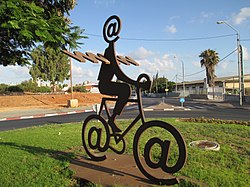
The Internet Messenger by Buky Schwartz in Holon.
The Internet carries an extensive range of information resource and services, such as the inter-linked hypertext documents and applications of the World Broad Web (WWW), the infrastructure to support email, and peer-to-peer networks for file sharing and telephony.
The origins of the Net appointment back to inquiry commissioned by the Us government in the 1960s to build robust, error-tolerant communication via computer networks.This work, combined with efforts in the United Kingdom and French republic, led to the primary precursor network, the ARPANET, in the United States. The interconnection of regional academic networks in the 1980s marks the commencement of the transition to the modern Cyberspace.From the early 1990s, the network experienced sustained exponential growth as generations of institutional, personal, and mobile computers were continued to it.
The funding of a new U.S. backbone by the National Science Foundation in the 1980s, as well as private funding for other commercial backbones, led to worldwide participation in the evolution of new networking technologies, and the merger of many networks.Though the Internet has been widely used by academia since the 1980s, the commercialization of what was past the 1990s an international network resulted in its popularization and incorporation into about every aspect of modern man life. As of 2014, 38 pct of the world'south human population has used the services of the Internet within the past year–over 100 times more people than were using it in 1995. Cyberspace use grew chop-chop in the West from the mid-1990s to early 2000s and from the tardily 1990s to present in the developing world.
Contents
- 1 History
- 2 Function
- two.i Linking
- ii.two Dynamic updates of web pages
- 2.three Www prefix
- ii.4 Scheme specifiers
- 3 Web security
- 4 Privacy
- 5 Standards
- 6 Accessibility
- 7 Internationalization
- viii Statistics
- ix Speed issues
- x Spider web caching
Nearly traditional communications media, including telephony and goggle box, are being reshaped or redefined by the Internet, giving birth to new services such as voice over Internet Protocol (VoIP) and Internet Protocol television (IPTV). Newspaper, book, and other print publishing are adapting to website technology, or are reshaped into blogging and spider web feeds. The entertainment manufacture, including music, moving picture, and gaming, was initially the fastest growing online segment. The Cyberspace has enabled and accelerated new forms of human interactions through instant messaging, Internet forums, and social networking. Online shopping has grown exponentially both for major retailers and pocket-sized artisans and traders. Concern-to-business and fiscal services on the Internet bear upon supply chains across unabridged industries.
The Cyberspace has no centralized governance in either technological implementation or policies for admission and usage; each constituent network sets its own policies.Simply the overreaching definitions of the two chief name spaces in the Cyberspace, the Internet Protocol address space and the Domain Proper noun System (DNS), are directed by a maintainer organization, the Internet Corporation for Assigned Names and Numbers (ICANN). The technical underpinning and standardization of the core protocols is an activity of the Cyberspace Engineering Task Forcefulness (IETF), a non-profit organization of loosely affiliated international participants that anyone may associate with past contributing technical expertise.
Terminology
The Internet, referring to the specific global organization of interconnected IP networks, is a nameand may exist written with an initial majuscule. In the media and mutual use it is often not capitalized, viz. the cyberspace. Some guides specify that the discussion should be capitalized when used every bit a noun, but non capitalized when used as an adjective.The Internet is besides often referred to equally the Net.
Historically the word internetted was used, uncapitalized, as early as 1849 as an describing word meaning "Interconnected; interwoven". The designers of early reckoner networks used internet both as a noun and as a verb in shorthand form of internetwork or internetworking, meaning interconnecting figurer networks.
The terms Internet and World wide web are often used interchangeably in everyday speech; it is common to speak of "going on the Internet" when invoking a spider web browser to view spider web pages. However, the World Broad Webor the Spider web is merely one of a large number of Internet services. The Spider web is a collection of interconnected documents (spider web pages) and other web resources, linked past hyperlinks and URLs. As another signal of comparison, Hypertext Transfer Protocol, or HTTP, is the language used on the Web for information transfer, yet it is just one of many languages or protocols that can be used for communication on the Internet.
The term Interweb is a portmanteau of Internet and World Broad Web typically used sarcastically to parody a technically unsavvy user.
History
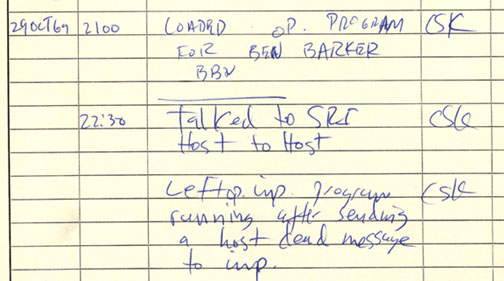
Text from the very starting time message e'er sent via the ARPANET.
Research into bundle switching started in the early on 1960s and packet switched networks such as Marking I at NPL in the Uk, ARPANET, CYCLADES, Merit Network, Tymnet, and Telenet, were adult in the late 1960s and early 1970s using a variety of protocols. The ARPANET in item led to the evolution of protocols for internet working, where multiple separate networks could exist joined together into a network of networks.
The commencement 2 nodes of what would get the ARPANET were interconnected betwixt Leonard Kleinrock's Network Measurement Center at the UCLA's School of Engineering and Applied science and Douglas Engelbart'due south NLS system at SRI International (SRI) in Menlo Park, California, on 29 October 1969. The tertiary site on the ARPANET was the Culler-Fried Interactive Mathematics center at the University of California at Santa Barbara, and the quaternary was the University of UtahGraphics Section. In an early on sign of future growth, there were already fifteen sites continued to the young ARPANET by the end of 1971.These early years were documented in the 1972 film Reckoner Networks: The Heralds of Resource Sharing.
Early on international collaborations on the ARPANET were rare. European developers were concerned with developing the 10.25networks.Notable exceptions were the Norwegian Seismic Array (NORSAR) in June 1973, followed in 1973 by Sweden with satellite links to the Tanum Globe Station and Peter T. Kirstein'south research group in the United kingdom of great britain and northern ireland, initially at the Institute of Figurer Science, University of London and afterwards at Academy College London.
In Dec 1974, RFC 675 – Specification of Net Transmission Command Program, by Vinton Cerf, Yogen Dalal, and Carl Sunshine, used the termcyberspace as a shorthand for internet working and later RFCs repeat this use.Admission to the ARPANET was expanded in 1981 when the National Science Foundation (NSF) adult the Information science Network (CSNET). In 1982, the Internet Protocol Suite (TCP/IP) was standardized and the concept of a earth-broad network of fully interconnected TCP/IP networks called the Net was introduced.

T3 NSFNET Courage, c. 1992.
TCP/IP network access expanded once again in 1986 when the National Science Foundation Network (NSFNET) provided access to supercomputer sites in the U.s. from research and education organizations, first at 56 kbit/s and later at 1.5 Mbit/south and 45 Mbit/s.Commercial Net service providers (ISPs) began to emerge in the late 1980s and early 1990s. The ARPANET was decommissioned in 1990. The Cyberspace was fully commercialized in the U.S. past 1995 when NSFNET was decommissioned, removing the concluding restrictions on the use of the Net to comport commercial traffic.The Internet started a rapid expansion to Europe and Commonwealth of australia in the mid to late 1980s and to Asia in the late 1980s and early 1990s.
Since the mid-1990s the Net has had a tremendous touch on culture and commerce, including the ascent of near instant advice by email, instant messaging, Vocalism over Internet Protocol (VoIP) "phone calls", two-way interactive video calls, and the World Wide Spider webwith its discussion forums, blogs, social networking, and online shopping sites. Increasing amounts of data are transmitted at higher and higher speeds over fiber optic networks operating at i-Gbit/south, 10-Gbit/southward, or more.
| 2005 | 2010 | 2014 a | |
| Earth population | 6.five billion | half-dozen.9 billion | 7.2 billion |
| Non using the Internet | 84% | lxx% | threescore% |
| Using the Internet | xvi% | 30% | 40% |
| Users in the developing earth | 8% | 21% | 32% |
| Users in the adult world | 51% | 67% | 78% |
| aApproximate. Source: International Telecommunication Union. | |||
The Internet continues to grow, driven by ever greater amounts of online information and knowledge, commerce, amusement and social networking. During the late 1990s, it was estimated that traffic on the public Internet grew by 100 percent per year, while the mean annual growth in the number of Internet users was thought to be betwixt 20% and l%.This growth is oftentimes attributed to the lack of central administration, which allows organic growth of the network, also equally the non-proprietary open nature of the Net protocols, which encourages vendor interoperability and prevents any one visitor from exerting too much control over the network.Every bit of 31 March 2011, the estimated total number of Net users was 2.095 billion (30.2% of earth population).It is estimated that in 1993 the Internet carried only 1% of the data flowing through two-way telecommunication, by 2000 this figure had grown to 51%, and by 2007 more 97% of all telecommunicated information was carried over the Internet.
Governance
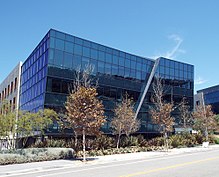
ICANN headquarters in the Playa Vista neighborhood of Los Angeles, California, United states of america.
The Internet is a globally distributed network comprising many voluntarily interconnected democratic networks. It operates without a fundamental governing body.
The technical underpinning and standardization of the core protocols (IPv4 and IPv6) is an activity of the Internet Technology Task Forcefulness (IETF), a non-profit organization of loosely affiliated international participants that anyone may associate with by contributing technical expertise.
To maintain interoperability, the principal name spaces of the Internet are administered by the Internet Corporation for Assigned Names and Numbers (ICANN), headquartered in the neighborhood of Playa Vista in the city of Los Angeles, California. ICANN is the potency that coordinates the assignment of unique identifiers for utilise on the Net, including domain names, Internet Protocol (IP) addresses, application port numbers in the transport protocols, and many other parameters. Globally unified proper name spaces, in which names and numbers are uniquely assigned, are essential for maintaining the global reach of the Internet. ICANN is governed past an international lath of directors drawn from across the Internet technical, business, academic, and other non-commercial communities. ICANN'southward role in coordinating the assignment of unique identifiers distinguishes it every bit perhaps the only central analogous body for the global Internet.
Regional Internet Registries (RIRs) allocate IP addresses:
- African Network Information Center (AfriNIC) for Africa
- American Registry for Internet Numbers (ARIN) for North America
- Asia-Pacific Network Information Center (APNIC) for Asia and the Pacific region
- Latin American and Caribbean area Internet Addresses Registry (LACNIC) for Latin America and the Caribbean region
- Réseaux IP Européens – Network Coordination Centre (RIPE NCC) for Europe, the Eye East, and Key Asia
The National Telecommunications and Information Administration, an agency of the U.s. Department of Commerce, continues to have final approving over changes to the DNS root zone.
The Internet Club (ISOC) was founded in 1992 with a mission to "assure the open development, evolution and use of the Net for the benefit of all people throughout the world".Its members include individuals (anyone may join) as well as corporations, organizations, governments, and universities. Amidst other activities ISOC provides an administrative habitation for a number of less formally organized groups that are involved in developing and managing the Net, including: the Cyberspace Engineering Task Force (IETF), Internet Architecture Board (IAB), Internet Technology Steering Grouping (IESG), Net Enquiry Task Forcefulness (IRTF), and Internet Research Steering Group (IRSG).
On sixteen November 2005, the United Nations-sponsored Globe Summit on the Information Society, held in Tunis, established the Net Governance Forum(IGF) to talk over Cyberspace-related problems.
Infrastructure
The communications infrastructure of the Internet consists of its hardware components and a system of software layers that command diverse aspects of the architecture.
Routing and service tiers
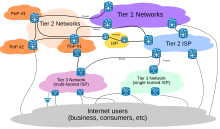
Packet routing across the Internet involves several tiers of Net service providers.
Internet service providers establish the world-broad connectivity between private networks at various levels of scope. End-users who only access the Cyberspace when needed to perform a function or obtain information, represent the bottom of the routing hierarchy. At the pinnacle of the routing hierarchy are the tier 1 networks, large telecommunication companies that exchange traffic directly with each other via peering agreements. Tier two and lower level networks buyInternet transit from other providers to reach at to the lowest degree some parties on the global Internet, though they may also appoint in peering. An ISP may utilise a single upstream provider for connectivity, or implement multihoming to accomplish redundancy and load balancing. Internet exchange points are major traffic exchanges with physical connections to multiple ISPs.
Large organizations, such as academic institutions, large enterprises, and governments, may perform the same role as ISPs, engaging in peering and purchasing transit on behalf of their internal networks. Research networks tend to interconnect with large subnetworks such as GEANT, GLORIAD, Internet2, and the UK's national research and education network, JANET.
It has been determined that both the Cyberspace IP routing construction and hypertext links of the World Wide Web are examples of scale-free networks.
Computers and routers utilise routing tables in their operating system to direct IP packets to the side by side-hop router or destination. Routing tables are maintained by manual configuration or automatically past routing protocols. Finish-nodes typically use a default road that points toward an ISP providing transit, while Isp routers use the Border Gateway Protocol to establish the nigh efficient routing across the complex connections of the global Internet.
Access
Common methods of Cyberspace access by users include dial-up with a reckoner modem via telephone circuits, broadband over coaxial cable, fiber optic or copper wires, Wi-Fi, satellite and cellular telephone engineering (3G, 4G). The Internet may ofttimes be accessed from computers in libraries and Cyberspace cafes.Net access points exist in many public places such as airport halls and coffee shops. Various terms are used, such equally public Internet kiosk, public admission last, and Web payphone. Many hotels as well take public terminals, though these are commonly fee-based. These terminals are widely accessed for various usage, such as ticket booking, bank eolith, or online payment. Wi-Fi provides wireless admission to the Net via local reckoner networks. Hotspots providing such access include Wi-Fi cafes, where users need to bring their ain wireless-enabled devices such as a laptop or PDA. These services may be gratuitous to all, costless to customers only, or fee-based.
Grassroots efforts have led to wireless community networks. Commercial Wi-Fi services covering large city areas are in identify in London, Vienna, Toronto, San Francisco, Philadelphia, Chicago and Pittsburgh. The Internet tin then exist accessed from such places as a park bench.Autonomously from Wi-Fi, there have been experiments with proprietary mobile wireless networks like Ricochet, various high-speed data services over cellular phone networks, and fixed wireless services. High-finish mobile phones such equally smartphones in full general come with Internet access through the phone network. Spider web browsers such as Opera are bachelor on these advanced handsets, which can also run a broad diverseness of other Internet software. More mobile phones have Internet access than PCs, though this is not as widely used.An Isp and protocol matrix differentiates the methods used to get online.
Protocols
While the hardware components in the Cyberspace infrastructure tin oft be used to support other software systems, it is the blueprint and the standardization process of the software that characterizes the Internet and provides the foundation for its scalability and success. The responsibility for the architectural blueprint of the Internet software systems has been causeless by the Cyberspace Engineering Task Forcefulness (IETF). The IETF conducts standard-setting work groups, open up to any individual, about the various aspects of Internet architecture. Resulting contributions and standards are published equally Request for Comments (RFC) documents on the IETF web site.
The principal methods of networking that enable the Internet are independent in peculiarly designated RFCs that constitute the Internet Standards. Other less rigorous documents are simply informative, experimental, or historical, or document the best current practices (BCP) when implementing Internet technologies.
The Internet standards describe a framework known as the Internet protocol suite. This is a model architecture that divides methods into a layered system of protocols, originally documented in RFC 1122 and RFC 1123. The layers correspond to the environment or scope in which their services operate. At the top is the application layer, the infinite for the application-specific networking methods used in software applications. For case, a web browser plan uses the customer-server awarding model and a specific protocol of interaction betwixt servers and clients, while many file-sharing systems use a peer-to-peer paradigm. Beneath this superlative layer, the ship layer connects applications on unlike hosts with a logical aqueduct through the network with appropriate data exchange methods.
Underlying these layers are the networking technologies that interconnect networks at their borders and hosts via the concrete connections. The internet layeren ables computers to identify and locate each other via Internet Protocol (IP) addresses, and routes their traffic via intermediate (transit) networks. Concluding, at the lesser of the compages is the link layer, which provides connectivity between hosts on the aforementioned network link, such as a physical connection in form of a local area network (LAN) or a punch-up connexion. The model, also known as TCP/IP, is designed to be contained of the underlying hardware, which the model therefore does not business organisation itself with in whatever item. Other models have been adult, such every bit the OSI model, that attempt to exist comprehensive in every aspect of communications. While many similarities be betwixt the models, they are not compatible in the details of description or implementation; indeed, TCP/IP protocols are usually included in the discussion of OSI networking.
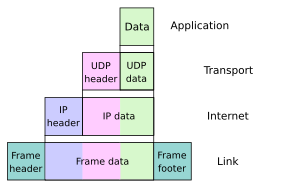
As user data is processed through the protocol stack, each abstraction layer adds encapsulation information at the sending host. Data is transmitted over the wire at the link level between hosts and routers. Encapsulation is removed by the receiving host. Intermediate relays update link encapsulation at each hop, and inspect the IP layer for routing purposes.
The most prominent component of the Internet model is the Internet Protocol (IP), which provides addressing systems (IP addresses) for computers on the Cyberspace. IP enables cyberspace working and in essence establishes the Net itself. Internet Protocol Version 4 (IPv4) is the initial version used on the start generation of the Internet and is still in dominant use. It was designed to address upwardly to ~iv.3 billion (ten9) Internet hosts. Nonetheless, the explosive growth of the Internet has led to IPv4 address exhaustion, which entered its final stage in 2011, when the global address allocation pool was exhausted. A new protocol version, IPv6, was developed in the mid-1990s, which provides vastly larger addressing capabilities and more efficient routing of Internet traffic. IPv6 is currently in growing deployment around the world, since Net accost registries (RIRs) began to urge all resource managers to plan rapid adoption and conversion.
IPv6 is not directly interoperable by design with IPv4. In essence, it establishes a parallel version of the Internet not directly accessible with IPv4 software. This means software upgrades or translator facilities are necessary for networking devices that need to communicate on both networks. Essentially all modernistic computer operating systems support both versions of the Net Protocol. Network infrastructure, however, is still lagging in this development. Aside from the complex assortment of physical connections that brand up its infrastructure, the Cyberspace is facilitated past bi- or multi-lateral commercial contracts, due east.g., peering agreements, and by technical specifications or protocols that describe how to substitution data over the network. Indeed, the Internet is defined by its interconnections and routing policies.
Services
The Internet carries many network services, well-nigh prominently the World Broad Web, electronic mail, Internet telephony, and File sharing services.
World wide web
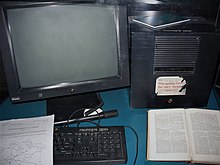
This Adjacent Figurer was used by Tim Berners-Lee at CERN and became the world's first Web server.
Many people use the terms Internet and World Broad Web, or simply the Spider web, interchangeably, simply the two terms are not synonymous. The Globe Broad Web is only i of hundreds of services used on the Net. The Spider web is a global set of documents, images and other resources, logically interrelated past hyperlinks and referenced with Compatible Resource Identifiers (URIs). URIs symbolically identify services, servers, and other databases, and the documents and resources that they tin can provide. Hypertext Transfer Protocol (HTTP) is the chief access protocol of the World wide web. Web services also use HTTP to allow software systems to communicate in club to share and substitution business organisation logic and data.
Globe Wide Spider web browser software, such as Microsoft'due south Net Explorer, Mozilla Firefox, Opera, Apple's Safari, and Google Chrome, lets users navigate from one spider web page to another via hyperlinks embedded in the documents. These documents may besides contain whatever combination of computer data, including graphics, sounds, text, video, multimedia and interactive content that runs while the user is interacting with the page. Client-side software can include animations, games, office applications and scientific demonstrations. Through keyword-driven Net research using search engines like Yahoo! and Google, users worldwide have easy, instant access to a vast and diverse amount of online information. Compared to printed media, books, encyclopedias and traditional libraries, the World Broad Web has enabled the decentralization of information on a big scale.
The Web has also enabled individuals and organizations to publish ideas and information to a potentially big audience online at profoundly reduced expense and time filibuster. Publishing a web page, a weblog, or edifice a website involves little initial price and many toll-complimentary services are available. However, publishing and maintaining large, professional web sites with attractive, various and upwardly-to-date information is still a difficult and expensive proposition. Many individuals and some companies and groups use web logs or blogs, which are largely used as easily updatable online diaries. Some commercial organizations encouragestaff to communicate communication in their areas of specialization in the hope that visitors will be impressed past the skillful knowledge and free information, and exist attracted to the corporation as a result.
One example of this practice is Microsoft, whose product developers publish their personal blogs in gild to pique the public's interest in their work. Collections of personal web pages published past large service providers remain popular, and have become increasingly sophisticated. Whereas operations such as Angelfire and GeoCities have existed since the early days of the Web, newer offerings from, for example, Facebook and Twitter currently take big followings. These operations often brand themselves as social network services rather than simply as web folio hosts.
Advertising on popular web pages can be lucrative, and eastward-commerce or the sale of products and services directly via the Spider web continues to grow.
When the Web developed in the 1990s, a typical web page was stored in completed course on a web server, formatted in HTML, complete for transmission to a web browser in response to a request. Over fourth dimension, the process of creating and serving web pages has become dynamic, creating flexible design, layout, and content. Websites are oftentimes created using content management software with, initially, very trivial content. Contributors to these systems, who may be paid staff, members of an organization or the public, fill underlying databases with content using editing pages designed for that purpose, while casual visitors view and read this content in HTML form. At that place may or may not be editorial, approval and security systems built into the procedure of taking newly entered content and making it bachelor to the target visitors.
Communication
Email is an important communications service bachelor on the Internet. The concept of sending electronic text messages betwixt parties in a style coordinating to mailing letters or memos predates the creation of the Internet. Pictures, documents and other files are sent every bit email attachments. Emails tin can be cc-ed to multiple email addresses.
Internet telephony is another common communications service made possible by the cosmos of the Cyberspace. VoIP stands for Voice-over-Internet Protocol, referring to the protocol that underlies all Net advice. The idea began in the early 1990s with walkie-talkie-like voice applications for personal computers. In recent years many VoIP systems have get as easy to apply and as convenient every bit a normal telephone. The benefit is that, equally the Internet carries the phonation traffic, VoIP can be gratis or price much less than a traditional phone call, especially over long distances and especially for those with always-on Net connections such as cable or ADSL. VoIP is maturing into a competitive alternative to traditional phone service. Interoperability between dissimilar providers has improved and the power to call or receive a call from a traditional telephone is available. Simple, inexpensive VoIP network adapters are available that eliminate the demand for a personal computer.
Voice quality can even so vary from call to telephone call, but is often equal to and can even exceed that of traditional calls. Remaining problems for VoIP include emergency telephone number dialing and reliability. Currently, a few VoIP providers provide an emergency service, but it is not universally available. Older traditional phones with no "actress features" may be line-powered only and operate during a power failure; VoIP can never do and then without a backup power source for the telephone equipment and the Internet access devices. VoIP has also become increasingly popular for gaming applications, as a form of communication between players. Popular VoIP clients for gaming include Ventrilo and Teamspeak. Modern video game consoles too offer VoIP chat features.
Data transfer
File sharing is an example of transferring large amounts of data across the Internet. A computer file can be emailed to customers, colleagues and friends equally an attachment. It can be uploaded to a website or FTP server for piece of cake download by others. It can be put into a "shared location" or onto a file server for instant utilize by colleagues. The load of bulk downloads to many users can be eased by the use of "mirror" servers or peer-to-peer networks. In any of these cases, access to the file may be controlled past user authentication, the transit of the file over the Internet may be obscured by encryption, and money may change hands for access to the file. The price tin exist paid by the remote charging of funds from, for example, a credit card whose details are also passed – commonly fully encrypted – across the Internet. The origin and authenticity of the file received may exist checked past digital signatures or past MD5 or other message digests. These simple features of the Internet, over a worldwide basis, are changing the production, auction, and distribution of annihilation that can be reduced to a computer file for transmission. This includes all manner of impress publications, software products, news, music, film, video, photography, graphics and the other arts. This in turn has caused seismic shifts in each of the existing industries that previously controlled the production and distribution of these products.
Streaming media is the existent-time commitment of digital media for the firsthand consumption or enjoyment by cease users. Many radio and television broadcasters provide Internet feeds of their live sound and video productions. They may also allow time-shift viewing or listening such equally Preview, Archetype Clips and Heed Again features. These providers accept been joined by a range of pure Internet "broadcasters" who never had on-air licenses. This means that an Internet-connected device, such as a computer or something more specific, tin can be used to access on-line media in much the same way every bit was previously possible only with a goggle box or radio receiver. The range of available types of content is much wider, from specialized technical webcasts to on-demand popular multimedia services. Podcasting is a variation on this theme, where – unremarkably audio – textile is downloaded and played back on a computer or shifted to a portable media thespian to exist listened to on the move. These techniques using unproblematic equipment allow anybody, with petty censorship or licensing control, to broadcast sound-visual material worldwide.
Digital media streaming increases the demand for network bandwidth. For example, standard image quality needs 1 Mbit/s link speed for SD 480p, HD 720p quality requires 2.v Mbit/southward, and the meridian-of-the-line HDX quality needs 4.5 Mbit/south for 1080p.
Webcams are a depression-price extension of this phenomenon. While some webcams can give full-frame-charge per unit video, the motion picture either is ordinarily small or updates slowly. Internet users can scout animals around an African waterhole, ships in the Panama Culvert, traffic at a local roundabout or monitor their own premises, live and in real time. Video chat rooms and video conferencing are besides popular with many uses being institute for personal webcams, with and without two-mode sound. YouTube was founded on 15 February 2005 and is now the leading website for free streaming video with a vast number of users. It uses a flash-based web thespian to stream and show video files. Registered users may upload an unlimited corporeality of video and build their own personal profile. YouTube claims that its users spotter hundreds of millions, and upload hundreds of thousands of videos daily. Currently, YouTube likewise uses an HTML5 player.
The Internet has enabled new forms of social interaction, activities, and social associations.
Users

Internet users per 100 inhabitants

Internet users by language.

Website content languages.
Overall Internet usage has seen tremendous growth. From 2000 to 2009, the number of Internet users globally rose from 394 million to 1.858 billion. By 2010, 22 per centum of the earth's population had access to computers with 1 billion Google searches every twenty-four hour period, 300 million Internet users reading blogs, and ii billion videos viewed daily on YouTube. In 2014 the world'southward Internet users surpassed 3 billion or 43.6 pct of earth population, but two-thirds of the users came from richest countries, with 78.0 percent of Europe countries population using the Net, followed by 57.four percent of the Americas.
The prevalent language for advice on the Internet has been English language. This may be a consequence of the origin of the Internet, every bit well every bit the language's role as a lingua franca. Early on computer systems were limited to the characters in the American Standard Code for Information Interchange (ASCII), a subset of the Latin alphabet.
Later on English (27%), the well-nigh requested languages on the Www are Chinese (25%), Spanish (8%), Japanese (5%), Portuguese and German language (4% each), Arabic, French and Russian (3% each), and Korean (two%).Past region, 42% of the earth'south Cyberspace users are based in Asia, 24% in Europe, 14% in North America, 10% in Latin America and the Caribbean taken together, 6% in Africa, 3% in the Middle East and 1% in Australia/Oceania.The Internet's technologies have developed enough in contempo years, especially in the use of Unicode, that skillful facilities are bachelor for development and communication in the globe's widely used languages. Still, some glitches such equally mojibake (incorrect display of some languages' characters) still remain.
In an American report in 2005, the percentage of men using the Internet was very slightly alee of the percentage of women, although this difference reversed in those under 30. Men logged on more often, spent more than time online, and were more probable to exist broadband users, whereas women tended to make more than employ of opportunities to communicate (such as electronic mail). Men were more probable to utilize the Internet to pay bills, participate in auctions, and for recreation such as downloading music and videos. Men and women were equally probable to use the Internet for shopping and banking.More recent studies indicate that in 2008, women significantly outnumbered men on most social networking sites, such as Facebook and Myspace, although the ratios varied with age.In addition, women watched more streaming content, whereas men downloaded more. In terms of blogs, men were more probable to web log in the beginning place; among those who weblog, men were more likely to have a professional blog, whereas women were more likely to have a personal blog.
According to forecasts by Euromonitor International, 44% of the world's population will be users of the Net past 2020. Splitting by state, in 2012 Iceland, Norway, Sweden, the Netherlands, and Denmark had the highest Net penetration past the number of users, with 93% or more of the population with access.
Several neologisms exist that refer to Internet users: Netizen (equally in equally in "citizen of the net")refers to those actively involved in improving online communities, the Internet in general or surrounding political diplomacy and rights such every bit free speech, Internaut refers to operators or technically highly capable users of the Cyberspace,digital citizen refers to a person using the Internet in order to engage in society, politics, and authorities participation.
Usage
The Internet allows greater flexibility in working hours and location, especially with the spread of unmetered high-speed connections. The Internet can be accessed about anywhere by numerous means, including through mobile Internet devices. Mobile phones, information cards, handheld game consoles and cellular routers permit users to connect to the Cyberspace wirelessly. Within the limitations imposed by small screens and other limited facilities of such pocket-size devices, the services of the Cyberspace, including email and the web, may be available. Service providers may restrict the services offered and mobile data charges may exist significantly higher than other admission methods.
Educational fabric at all levels from pre-school to mail service-doctoral is bachelor from websites. Examples range from CBeebies, through school and high-school revision guides and virtual universities, to access to elevation-end scholarly literature through the likes of Google Scholar. For altitude education, assist with homework and other assignments, self-guided learning, whiling away spare fourth dimension, or just looking up more particular on an interesting fact, it has never been easier for people to access educational information at whatever level from anywhere. The Internet in general and the World wide web in particular are of import enablers of both formal and informal education. Further, the Internet allows universities, in detail researchers from the social and behavioral sciences, to acquit research remotely via virtual laboratories, with profound changes in attain and generalizability of findings equally well every bit in advice betwixt scientists and in the publication of results.
The low cost and nearly instantaneous sharing of ideas, noesis, and skills has made collaborative work dramatically easier, with the assistance of collaborative software. Non only can a group cheaply communicate and share ideas only the broad reach of the Net allows such groups more easily to class. An example of this is the gratis software movement, which has produced, among other things, Linux, Mozilla Firefox, and OpenOffice.org. Internet chat, whether using an IRC chat room, an instant messaging system, or a social networking website, allows colleagues to stay in affect in a very convenient way while working at their computers during the day. Messages can be exchanged even more than quickly and conveniently than via electronic mail. These systems may allow files to be exchanged, drawings and images to be shared, or vocalism and video contact betwixt squad members.
Content management systems allow collaborating teams to piece of work on shared sets of documents simultaneously without accidentally destroying each other's work. Business and project teams can share calendars as well every bit documents and other data. Such collaboration occurs in a wide variety of areas including scientific research, software development, conference planning, political activism and creative writing. Social and political collaboration is also becoming more than widespread as both Internet access and computer literacy spread.
The Internet allows computer users to remotely access other computers and information stores easily, wherever they may be. They may do this with or without computer security, i.e. hallmark and encryption technologies, depending on the requirements. This is encouraging new ways of working from home, collaboration and information sharing in many industries. An accountant sitting at home tin can audit the books of a company based in another country, on a server situated in a third country that is remotely maintained past IT specialists in a fourth. These accounts could have been created past domicile-working bookkeepers, in other remote locations, based on information emailed to them from offices all over the world. Some of these things were possible before the widespread use of the Internet, merely the toll of individual leased lines would take made many of them infeasible in practice. An office worker away from their desk, perchance on the other side of the world on a business trip or a holiday, tin access their emails, admission their data using cloud calculating, or open a remote desktop session into their office PC using a secure Virtual Private Network (VPN) connectedness on the Cyberspace. This can give the worker complete admission to all of their normal files and information, including electronic mail and other applications, while away from the part. It has been referred to among system administrators every bit the Virtual Private Nightmare, considering it extends the secure perimeter of a corporate network into remote locations and its employees' homes.
Social networking and entertainment
Many people employ the World wide web to access news, weather and sports reports, to plan and book vacations and to pursue their personal interests. People use chat, messaging and email to brand and stay in touch with friends worldwide, sometimes in the aforementioned way every bit some previously had pen pals.
Social networking websites such equally Facebook, Twitter, and Myspace have created new ways to socialize and interact. Users of these sites are able to add a broad variety of data to pages, to pursue common interests, and to connect with others. Information technology is likewise possible to detect existing acquaintances, to allow communication among existing groups of people. Sites like LinkedIn foster commercial and business connections. YouTube and Flickr specialize in users' videos and photographs.
While social networking sites were initially for individuals merely, today they are widely used by businesses and other organizations to promote their brands, to market to their customers and to encourage posts to "go viral". "Black chapeau" social media techniques are also employed by some organizations, such as spam accounts and astroturfing.
A risk for both individuals and organizations writing posts (specially public posts) on social networking websites, is that particularly foolish or controversial posts occasionally lead to an unexpected and possibly big-scale backlash on social media from other internet users. This is also a hazard in relation to controversial offline behavior, if it is widely made known. The nature of this backfire can range widely from counter-arguments and public mockery, through insults and hate speech communication, to, in extreme cases, rape and death threats. The online disinhibition effect describes the tendency of many individuals to behave more stridently or offensively online than they would in person. A significant number of feminist women take been the target of diverse forms of harassment in response to posts they have made on social media, and Twitter in detail has been criticised in the by for not doing enough to assist victims of online corruption.
For organizations, such a backlash tin can cause overall brand damage, particularly if reported by the media. However, this is non always the example, as any make damage in the eyes of people with an opposing opinion to that presented past the organization could sometimes exist outweighed by strengthening the make in the optics of others. Furthermore, if an system or private gives in to demands that others perceive equally incorrect-headed, that can then provoke a counter-backlash.
Some websites, such as Reddit, take rules forbidding the posting of personal data of individuals (likewise known every bit doxxing), due to concerns about such postings leading to mobs of large numbers of Internet users directing harassment at the specific individuals thereby identified. In particular, the Reddit dominion forbidding the posting of personal information is widely understood to imply that all identifying photos and names must be censored in Facebook screenshots posted to Reddit. Nonetheless, the estimation of this dominion in relation to public Twitter posts is less clear, and in whatsoever case like-minded people online accept many other means they can use to directly each other's attention to public social media posts they disagree with.
Children also face dangers online such as cyberbullying and approaches by sexual predators, who sometimes pose as children themselves. Children may as well encounter fabric which they may find upsetting, or textile which their parents consider to exist not age-advisable. Due to naivety, they may also post personal information almost themselves online, which could put them or their families at risk, unless warned not to practise so. Many parents choose to enable internet filtering, and/or supervise their children'south online activities, in an endeavor to protect their children from inappropriate material on the internet. The well-nigh pop social networking websites, such as Facebook and Twitter, usually forbid users under the historic period of 13. However, these policies are typically piffling to circumvent past registering an account with a false nascency date, and a pregnant number of children aged under xiii join such sites anyway. Social networking sites for younger children, which claim to provide better levels of protection for children, also exist.
The Internet has been a major outlet for leisure action since its inception, with entertaining social experiments such equally MUDs and MOOs beingness conducted on university servers, and humor-related Usenet groups receiving much traffic. Today, many Internet forums have sections devoted to games and funny videos. Over 6 million people use blogs or bulletin boards as a means of communication and for the sharing of ideas. The Internet pornography and online gambling industries have taken reward of the World Broad Web, and oftentimes provide a pregnant source of advertising revenue for other websites. Although many governments have attempted to restrict both industries' use of the Internet, in full general this has failed to stop their widespread popularity.

Image created for a GameSpy contest.
Some other area of leisure activity on the Internet is multiplayer gaming. This class of recreation creates communities, where people of all ages and origins savor the fast-paced world of multiplayer games. These range from MMORPG to starting time-person shooters, from role-playing video games to online gambling. While online gaming has been effectually since the 1970s, modern modes of online gaming began with subscription services such as GameSpy and MPlayer.Non-subscribers were express to certain types of game play or certain games. Many people utilize the Internet to access and download music, movies and other works for their enjoyment and relaxation. Free and fee-based services be for all of these activities, using centralized servers and distributed peer-to-peer technologies. Some of these sources exercise more than intendance with respect to the original artists' copyrights than others.
Net usage has been correlated to users' loneliness.Lonely people tend to use the Cyberspace equally an outlet for their feelings and to share their stories with others, such as in the "I am lonely will anyone speak to me" thread.
Cybersectarianism is a new organizational form which involves: "highly dispersed small groups of practitioners that may remain largely bearding inside the larger social context and operate in relative secrecy, while yet linked remotely to a larger network of believers who share a gear up of practices and texts, and often a common devotion to a particular leader. Overseas supporters provide funding and back up; domestic practitioners distribute tracts, participate in acts of resistance, and share information on the internal situation with outsiders. Collectively, members and practitioners of such sects construct viable virtual communities of organized religion, exchanging personal testimonies and engaging in collective study via e-mail, on-line chat rooms and web-based message boards." In item, the British authorities has raised concerns about the prospect of immature British Muslims being indoctrinated into Islamic extremism past fabric on the Internet, being persuaded to join terrorist groups such as the then-chosen "Islamic State", and and then potentially committing acts of terrorism on returning to Britain after fighting in Syria or Iraq.
Cyberslacking can go a drain on corporate resources; the average UK employee spent 57 minutes a day surfing the Web while at piece of work, according to a 2003 study by Peninsula Concern Services. Cyberspace habit disorder is excessive computer use that interferes with daily life. Psychologist Nicolas Carr believe that Internet utilize has other effects on individuals, for instance improving skills of browse-reading and interfering with the deep thinking that leads to true creativity.
Electronic business
Electronic business (e-business) encompasses business processes spanning the entire value concatenation: purchasing, supply chain management, marketing, sales, customer service, and business organisation human relationship. Eastward-commerce seeks to add revenue streams using the Internet to build and enhance relationships with clients and partners.
According to International Data Corporation, the size of worldwide eastward-commerce, when global business-to-business and -consumer transactions are combined, equate to $16 trillion for 2013. A study by Oxford Economics adds those 2 together to estimate the total size of the digital economy at $xx.4 trillion, equivalent to roughly xiii.8% of global sales.
Drawbacks
While much has been written of the economic advantages of Net-enabled commerce, there is also evidence that some aspects of the Internet such as maps and location-aware services may serve to reinforce economical inequality and the digital divide. Electronic commerce may be responsible for consolidation and the decline of mom-and-pop, brick and mortar businesses resulting in increases in income inequality.
Writer Andrew Keen, a long-time critic of the social transformations caused by the Net, has recently focused on the economical effects of consolidation from Internet businesses. Keen cites a 2013 Institute for Local Self-Reliance report saying brick-and-mortar retailers apply 47 people for every $ten million in sales, while Amazon employs only 14. Similarly, the 700-employee room rental start-up Airbnb was valued at $x billion in 2014, well-nigh one-half as much as Hilton Hotels, which employs 152,000 people. And motorcar-sharing Internet startup Uber employs 1,000 full-time employees and is valued at $18.2 billion, about the same valuation as Avis and Hertz combined, which together employ nigh 60,000 people.
Telecommuting
Remote work is facilitated by tools such as groupware, virtual private networks, conference calling, videoconferencing, and Vox over IP (VOIP). It can exist efficient and useful for companies equally it allows workers to communicate over long distances, saving significant amounts of travel time and cost. Every bit broadbandInternet connections become more commonplace, more and more than workers have acceptable bandwidth at abode to use these tools to link their home to their corporate intranet and internal phone networks.
Crowdsourcing
Internet provides a especially good venue for crowdsourcing (outsourcing tasks to a distributed group of people) since individuals tend to be more open in web-based projects where they are not being physically judged or scrutinized and thus can experience more comfortable sharing.
Crowdsourcing systems are used to achieve a multifariousness of tasks. For case, the crowd may be invited to develop a new technology, bear out a design task, refine or acquit out the steps of an algorithm (run into human-based ciphering), or aid capture, systematize, or analyze large amounts of information (see also citizen science).
Wikis have as well been used in the academic customs for sharing and dissemination of information across institutional and international boundaries. In those settings, they have been found useful for collaboration on grant writing, strategic planning, departmental documentation, and committee piece of work.The United States Patent and Trademark Office uses a wiki to allow the public to collaborate on finding prior art relevant to examination of pending patent applications. Queens, New York has used a wiki to allow citizens to collaborate on the design and planning of a local park.
The English Wikipedia has the largest user base of operations amongst wikis on the Globe Broad Web and ranks in the acme ten amid all Web sites in terms of traffic.
Politics and political revolutions

Banner in Bangkok during the 2014 Thai coup d'état, informing the Thai public that 'like' or 'share' activities on social media could result in imprisonment (observed June 30, 2014).
The Internet has accomplished new relevance as a political tool. The presidential campaign of Howard Dean in 2004 in the United States was notable for its success in soliciting donation via the Internet. Many political groups employ the Internet to achieve a new method of organizing for carrying out their mission, having given rise to Internet activism, most notably skillful by rebels in the Arab Jump.
The New York Times suggested that social media websites, such as Facebook and Twitter, helped people organize the political revolutions in Egypt, by helping activists organize protests, communicate grievances, and disseminate information.
The potential of the Internet every bit a civic tool of communicative power was explored by Simon R. B. Berdal in his 2004 thesis:
As the globally evolving Cyberspace provides ever new access points to virtual discourse forums, it also promotes new civic relations and associations inside which communicative ability may flow and accumulate. Thus, traditionally … national-embedded peripheries get entangled into greater, international peripheries, with stronger combined powers… The Net, every bit a consequence, changes the topology of the "centre-periphery" model, past stimulating conventional peripheries to interlink into "super-periphery" structures, which enclose and "congregate" several centers at once.
Berdal, therefore, extends the Habermasian notion of the Public sphere to the Internet, and underlines the inherent global and civic nature that interwoven Internet technologies provide. To limit the growing civic potential of the Internet, Berdal also notes how "self-protective measures" are put in place by those threatened by it:
If nosotros consider Communist china'southward attempts to filter "unsuitable material" from the Internet, nearly of us would agree that this resembles a cocky-protective mensurate by the system confronting the growing civic potentials of the Internet. Nevertheless, both types represent limitations to "peripheral capacities". Thus, the Chinese government tries to forbid communicative power to build up and unleash (as the 1989 Tiananmen Square uprising suggests, the government may detect it wise to install "upstream measures"). Even though limited, the Internet is proving to exist an empowering tool besides to the Chinese periphery: Analysts believe that Internet petitions have influenced policy implementation in favor of the public's online-articulated volition …
Incidents of politically motivated Internet censorship have now been recorded in many countries, including western democracies.
Philanthropy
The spread of depression-price Internet admission in developing countries has opened upward new possibilities for peer-to-peer charities, which allow individuals to contribute small amounts to charitable projects for other individuals. Websites, such as DonorsChoose and GlobalGiving, let pocket-sized donors to direct funds to individual projects of their choice.
A pop twist on Cyberspace-based philanthropy is the use of peer-to-peer lending for charitable purposes. Kiva pioneered this concept in 2005, offering the first web-based service to publish individual loan profiles for funding. Kiva raises funds for local intermediary microfinance organizations which post stories and updates on behalf of the borrowers. Lenders can contribute as footling as $25 to loans of their choice, and receive their money back as borrowers repay. Kiva falls brusque of being a pure peer-to-peer charity, in that loans are disbursed before being funded past lenders and borrowers exercise not communicate with lenders themselves.
Nevertheless, the contempo spread of depression price Internet access in developing countries has made 18-carat international person-to-person philanthropy increasingly feasible. In 2009 the The states-based nonprofit Zidisha tapped into this tendency to offer the first person-to-person microfinance platform to link lenders and borrowers across international borders without intermediaries. Members tin fund loans for as piffling as a dollar, which the borrowers then use to develop business organisation activities that meliorate their families' incomes while repaying loans to the members with interest. Borrowers access the Internet via public cybercafes, donated laptops in hamlet schools, and fifty-fifty smart phones, then create their ain profile pages through which they share photos and information well-nigh themselves and their businesses. As they repay their loans, borrowers go on to share updates and dialogue with lenders via their contour pages. This direct spider web-based connection allows members themselves to have on many of the advice and recording tasks traditionally performed past local organizations, bypassing geographic barriers and dramatically reducing the toll of microfinance services to the entrepreneurs.
Security
Many calculator scientists depict the Internet as a "prime example of a large-scale, highly engineered, however highly circuitous organisation".The construction was found to be highly robust to random failures,yet, very vulnerable to intentional attacks.
The Cyberspace structure and its usage characteristics have been studied extensively and the possibility of developing culling structures has been investigated.
Cyberspace resources, hardware and software components, are the target of malicious attempts to proceeds unauthorized control to crusade interruptions, or access private information. Such attempts include computer viruses which copy with the aid of humans, computer worms which copy themselves automatically, denial of service attacks, ransomware, botnets, and spyware that reports on the activity and typing of users. Usually these activities constitute cybercrime. Defense theorists have likewise speculated nearly the possibilities of cyber warfare using like methods on a large calibration.
Surveillance
The vast majority of computer surveillance involves the monitoring of information and traffic on the Net. In the The states for example, nether the Communications Assistance For Police Enforcement Human activity, all phone calls and broadband Internet traffic (emails, spider web traffic, instant messaging, etc.) are required to be available for unimpeded real-time monitoring by Federal law enforcement agencies.
Package capture (as well sometimes referred to as "packet sniffing") is the monitoring of data traffic on a estimator network. Computers communicate over the Internet by breaking upwards messages (emails, images, videos, web pages, files, etc.) into small chunks called "packets", which are routed through a network of computers, until they attain their destination, where they are assembled back into a complete "message" again. Packet Capture Appliance intercepts these packets as they are traveling through the network, in order to examine their contents using other programs. A packet capture is an information gathering tool, but not an assay tool. That is information technology gathers "messages" but it does non analyze them and effigy out what they mean. Other programs are needed to perform traffic analysis and sift through intercepted data looking for important/useful information. Under the Communications Assistance For Constabulary Enforcement Act all U.S. telecommunications providers are required to install packet sniffing engineering to allow Federal law enforcement and intelligence agencies to intercept all of their customers' broadband Internet and voice over Cyberspace protocol (VoIP) traffic.
At that place is far too much data gathered by these packet sniffers for human investigators to manually search through all of information technology. So automated Internet surveillance computers sift through the vast amount of intercepted Internet traffic, and filter out and study to human investigators those bits of data which are "interesting"—such as the use of certain words or phrases, visiting certain types of spider web sites, or communicating via email or chat with a certain individual or group.Billions of dollars per yr are spent, by agencies such as the Data Awareness Office, NSA, GCHQ and the FBI, to develop, purchase, implement, and operate systems which intercept and clarify all of this data, and extract only the information which is useful to law enforcement and intelligence agencies.
Similar systems are now operated by Iranian secret police force to place and suppress dissidents. All required hardware and software has been allegedly installed by High german Siemens AG and Finnish Nokia.
Censorship
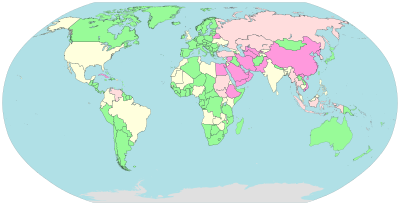
Internet censorship and surveillance past country

Some governments, such as those of Burma, Iran, Democratic people's republic of korea, the Mainland China,Kingdom of saudi arabia and the United Arab Emirates restrict access to content on the Cyberspace within their territories, specially to political and religious content, with domain name and keyword filters.
In Kingdom of norway, Denmark, Finland, and Sweden, major Internet service providers take voluntarily agreed to restrict access to sites listed by government. While this list of forbidden resources is supposed to contain only known kid pornography sites, the content of the list is cloak-and-dagger. Many countries, including the Usa, have enacted laws confronting the possession or distribution of certain material, such equally kid pornography, via the Internet, simply do not mandate filter software. Many gratis or commercially bachelor software programs, called content-control software are available to users to block offensive websites on individual computers or networks, in order to limit access by children to pornographic fabric or depiction of violence.
Performance
As the Cyberspace is a heterogeneous network, the physical characteristics, including for instance the information transfer rates of connections, vary widely. It exhibits emergent phenomena that depend on its big-scale organization.
Outages
An Net coma or outage can be caused by local signaling interruptions. Disruptions of submarine communications cables may cause blackouts or slowdowns to big areas, such equally in the 2008 submarine cablevision disruption. Less-developed countries are more vulnerable due to a pocket-size number of high-capacity links. State cables are also vulnerable, equally in 2011 when a adult female digging for scrap metal severed most connectivity for the nation of Armenia.Internet blackouts affecting almost entire countries tin can be accomplished past governments every bit a form of Internet censorship, as in the blockage of the Internet in Egypt, whereby approximately 93% of networks were without access in 2011 in an try to stop mobilization for anti-government protests.
Energy use
In 2011 researchers estimated the energy used by the Net to be between 170 and 307 GW, less than two pct of the energy used by humanity. This estimate included the energy needed to build, operate, and periodically replace the estimated 750 million laptops, a billion smart phones and 100 million servers worldwide equally well every bit the free energy that routers, cell towers, optical switches, Wi-Fi transmitters and deject storage devices use when transmitting Net traffic.
Source: https://courses.lumenlearning.com/computerapps/chapter/reading-the-internet/
0 Response to "What Is One of the Core Characteristics of the Internet That Has Contributed to Its Rapid Growth?"
Publicar un comentario